

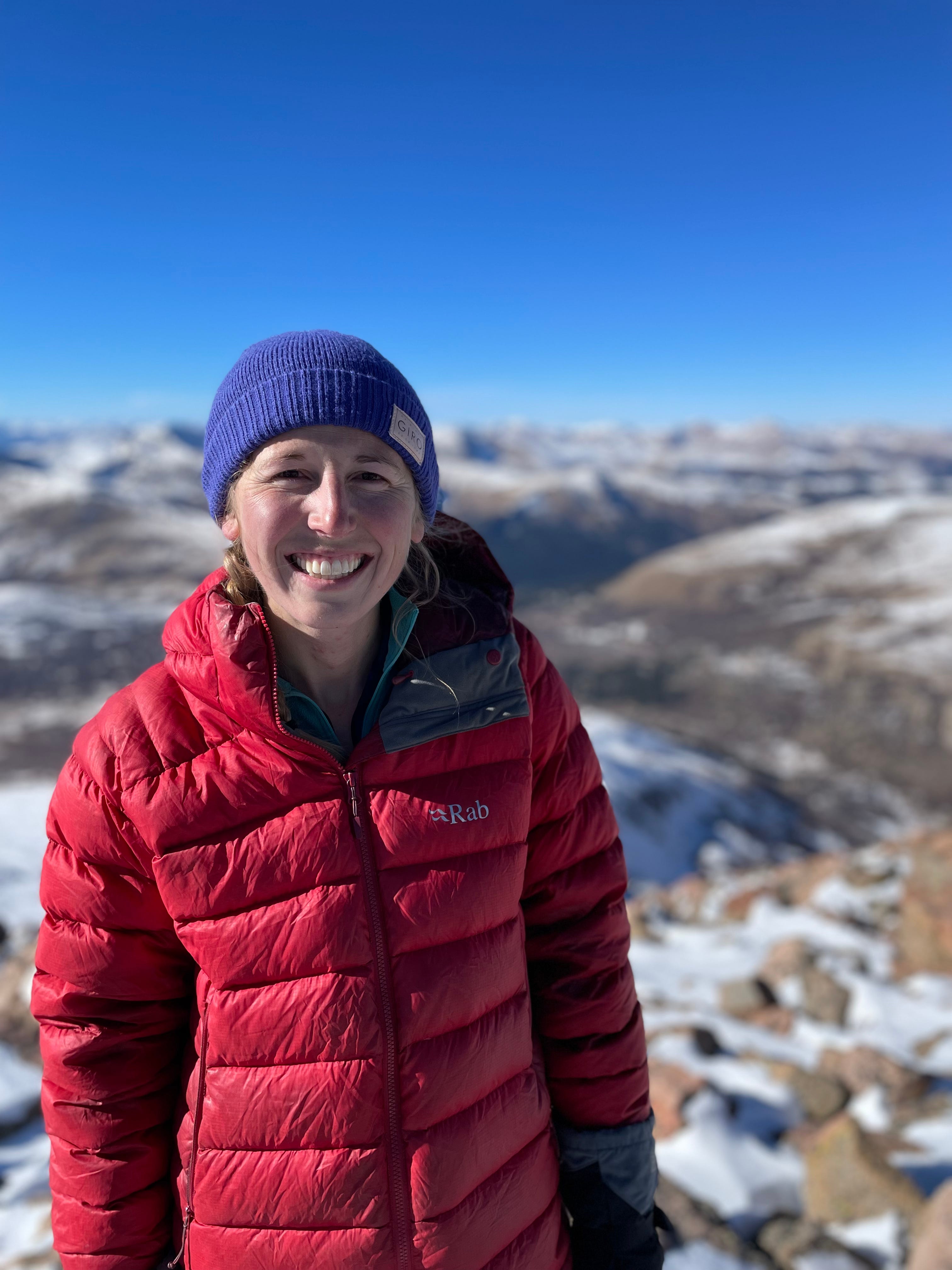
Alyssa Leib, MS, RD, is a Registered Dietitian and the owner of Peak to Peak Nutrition. She works with mountain athletes (trail runners, rock climbers, mountaineers, skiers, etc.) of all levels to help them dial in their nutrition to perform and feel their best. Alyssa believes that mental health is just as important as physical health and supports every athlete she works with in building and nurturing a positive relationship with food and their bodies. Alyssa practices through a weight-inclusive lens, is aligned with Health at Every Size, and incorporates Intuitive Eating principles into her work with athletes.
When she’s not geeking out about gut training or sweat science, you can find Alyssa playing in the mountains of Colorado with her border collies, Yampa and Jackson.
How did you get into trail running (& climbing & skiing & snowboarding & hiking & all things mountain sports!) and what keeps you coming back?
I grew up along the Appalachian Trail. My parents were avid hikers, skiers, and cyclists, so we were always getting outside. I mostly played soccer growing up and outside of laps around the field (and two seasons on my middle school track team), I didn’t do much running until college when I trained for my first half marathon.
A bone stress injury in 2014 took me away from running for about 5 years. During that time, I moved to Colorado and really leaned into skiing, hiking, and rock climbing—things I could do without pain. By the time I was healthy enough to return to running, I knew I wanted to spend more time on trails.
I joke that my favorite part of trail running is getting to see more pretty things than I could hiking. It’s not that far from the truth - whether I’m on foot or on skis, mountain sports are really all just an excuse to spend time in beautiful places. It’s also fun to push my body and see what it can do when I treat it well.
What is your favorite mile on a long run? Why? What about least?
The first mile is always the worst.
The best? I love the last mile before you get to the top of a big climb—when you know you’re about to be rewarded for your hard work with a great view.
What is the biggest (life/health/personal) lesson being an athlete has taught you?
As cliche as it sounds: I can do hard things.
Have athletics impacted your relationship with food? If so, how?
I am fortunate now to be in a place where movement is a celebration of all that my body can do. But it wasn’t always that way.
My relationships with both food and athletics have evolved a lot over the years. I started running in college, that relationship was closely intertwined with food. Like many, a big impetus for getting into running in the first place was in response to gaining the “freshman 15” (which I now realize is a normal aspect of development). Running was a tool for control AND also gave me a sense of freedom and power that I had never felt before. As I slid into the depths of an eating disorder, it was in the context of a dual relationship with running: a sport that both pulled me out and spiraled me even deeper.
So many things factored into my recovery, but in part, I have rock climbing to thank for developing a healthier relationship with exercise. For the first time in years, I had a way to move and celebrate my body… and had NO idea how many calories I was burning. Climbing was about strength, movement, and community.
For the first time in years, I had a way to move and celebrate my body… and had NO idea how many calories I was burning.
Have you ever experienced REDS, disordered eating, or had an eating disorder?
Oh yes! I was never formally diagnosed with anything, but struggled with an eating disorder during and after college. I never lost my period (which undoubtedly contributed to my thoughts about not being “sick enough”) but did develop a bone stress injury that caused lasting damage and took years to heal.
I DIY’d my recovery, which I would never recommend. I won’t say I’m grateful for the experience, but it did lead me to a career change and I am grateful every day for the incredible athletes who trust me to be a part of their recovery journeys.
Some of my biggest takeaways from my own experience:
Running to eat will always backfire. Eat to run.
“Looking like” an athlete doesn't make you a good athlete. Bodies of every shape and size do badass things— seriously, go hang out at the finish line of any ultramarathon and you’ll see that.
Recovery allows you to have a bigger life —that includes food and sport but is so much more. It is so worth it.
Can you tell us about your most difficult run/race/hike? How did you overcome that?
I’ve had a lot of rough days in the mountains. To this day, the biggest physical challenge I’ve had to overcome was pushing through the unfortunate combination of food poisoning and altitude sickness on Mount Kilimanjaro, the highest point in Africa (19,341 ft). On Kili, the guides and porters always tell you, “pole pole” which means “slowly” in Swahili. The idea is that if you slow down, you can keep going, which proved very true for me on our summit day when it took me 7 hours to hike 5 kilometers. At one point, I felt so terrible, I had to sit down to catch my breath after every 10 steps. But by going “pole pole” and counting steps to track progress, I made it to the top. Whenever I’m going through a hard time - whether it’s a long climb that feels impossible, a speed workout, or a stressful period of work—I remind myself that as long as I keep putting one foot in front of the other, I’ll make it.
What are the biggest nutrition misconceptions you see in the mountain sports world? What should people be doing differently?
I could write a whole article just on this topic! If I had to narrow it down, the top 3 would be:
Lighter is faster/stronger: this belief seems less common than it was 15 years ago but it is still so common, especially in the climbing and mountaineering worlds. But research (and practice) could not be more clear here—fueled is faster. I have seen it time and time again—when an athlete puts their desire to be lighter on the back burner and really focuses on nourishing their body, they feel and perform better.
Fasted training: “fat adaptation” sounds so sexy but the reality is, fasted training has not panned out as a tool to improve performance. Instead, fasted training actually does the opposite, worsening performance and increasing injury risk (especially in women). I recommend at least 40-80 grams of carbs pre-workout (yes, even before a 30-minute easy run).
Only pros need to worry about nutrition: if you run, you’re a runner. If you train with intention, you’re an athlete. You deserve to nourish your body, even if you’re not winning races or setting FKTs. You owe it to yourself.
What's the most important thing you want women to know about endurance sports?
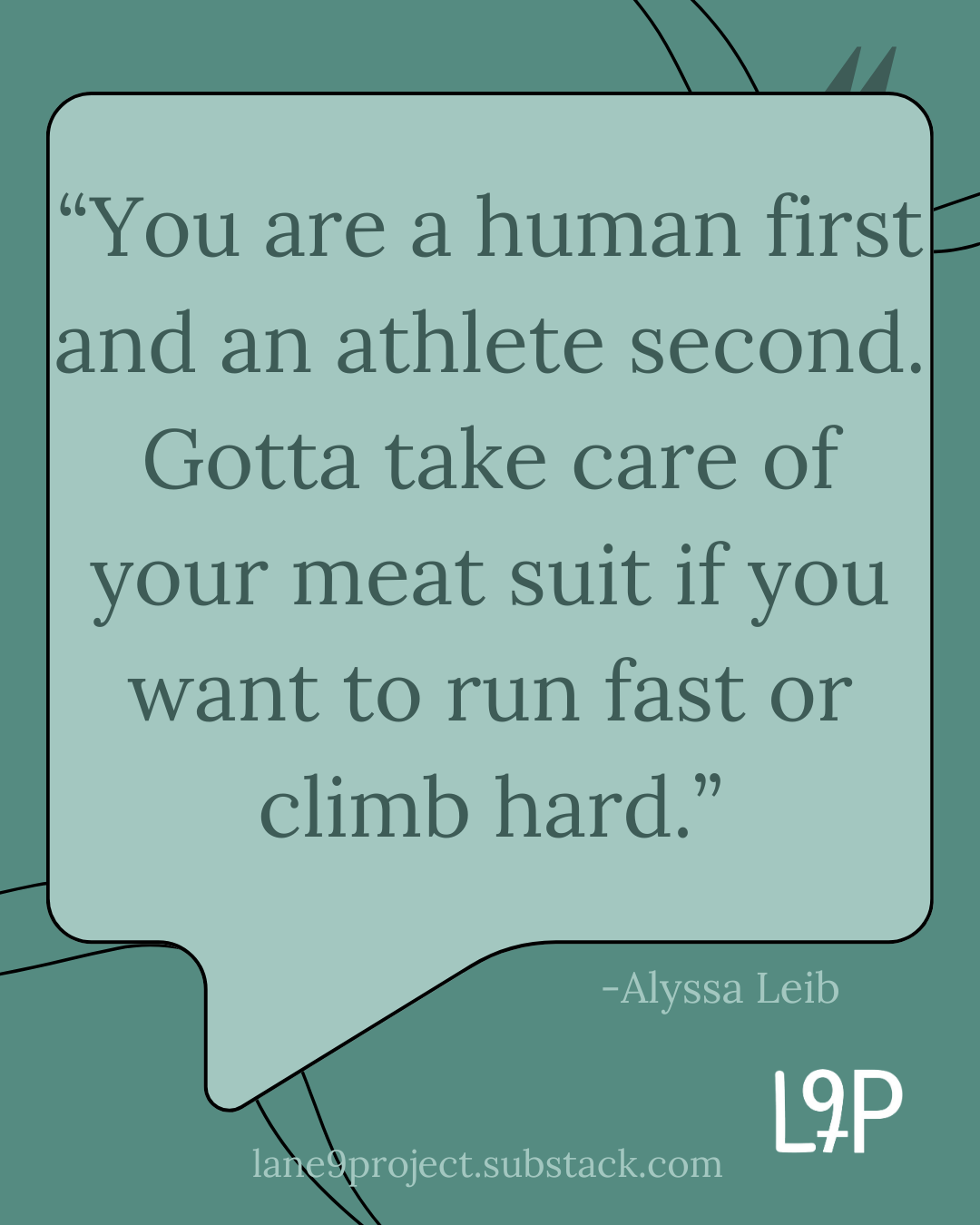
You are a human first and an athlete second. Gotta take care of your meat suit if you want to run fast or climb hard.'
What is something professionally, personally, or athletically you’re proud of lately?
I’m currently closing out the biggest and most consistent training block of my life (building toward the Golden Ultra 3-day stage race in British Columbia). After a very slow build back from my bone stress injury in 2014, it has felt unbelievably good to trust in the process again. For years after returning to running after my injury, I constantly feared someone would jump out of the bushes and shout “psych!” at me and take away running again. During the past year, I’ve been able to add speed work back in, set time-based goals, and really push myself for the first time in over a decade. And it’s all because I’ve been able to listen to and nourish my body.